LED Warehouse High Bay Lighting
Correct lighting is an essential component for any industrial setting, especially for warehouses where accuracy and safety are key. As the focus on energy efficiency intensifies, LED Warehouse High Bay Lighting is increasingly becoming the go-to choice for smart businesses everywhere.
At Superior Lighting, we offer a range of quality, energy-efficient lighting designed for the specific needs of today’s warehouses. Keep reading to discover how the right lighting fixtures can illuminate your warehouse while saving on energy and reducing your overhead costs.
LED Warehouse High Bay Lighting Product Filters
Shop Top LED Warehouse High Bay Lighting Categories

Shop Top LED Warehouse High Bay Lighting Products







LED Warehouse High Bay Lighting Trending Guides
Question 1: How do I choose the right high bay?
Question 2: What is the difference between a UFO and linear LED high bay?
Question 3: How do I choose the right wattage for high bay lighting?
Question 4: What color temperature should I choose for a high bay fixture?
Question 5: How do I used a watt selectable high bay light?
Question 6: Why should I use a high bay retrofit LED bulb?
Question 7: Which should I choose, an LED corn bulb or a high bay LED fixture?
Understanding Warehouse Lighting Needs
A warehouse is a complex environment requiring specialized lighting. Effective warehouse lighting should meet several key criteria: scale, brightness, durability, and coverage. Scale and coverage refer to the size of the space you’re illuminating. Warehouses are large spaces that need evenly distributed lighting, so no corner is left in the dark.
Brightness, often measured in lumens, is also essential because adequate light is crucial for tasks like reading labels, operating machinery, and ensuring the safety of your workforce. Traditional light sources, such as incandescent or fluorescent lighting fixtures, often struggle to meet these needs. They either consume too much power or require frequent replacements, leading to increased operational costs and maintenance hassles.
Moreover, traditional lights can contribute to visual fatigue for your employees, affecting both productivity and safety. Simply put, outdated light fixtures are a dim idea when it comes to meeting modern warehouse requirements.
Why LED Warehouse High Bay Lighting is the Ideal Choice
Energy Efficiency
The push for sustainability and operational efficiency is making LED warehouse lighting a critical choice for warehouses. One of the most compelling benefits of high bay lights is its energy efficiency. Unlike traditional light sources, which waste a lot of energy as heat, LEDs convert nearly 95% of the energy they consume into light.
This optimized energy consumption not only helps reduce your electricity bills but also makes a significant impact on your carbon footprint. When you consider the size of a warehouse, these savings can be quite substantial over time.
Longevity
Another feature that sets LED lighting apart is its longevity. The average LED light can last up to 50,000 hours or more, depending on the brand and usage, drastically outliving traditional lighting options. This means fewer replacements and less time spent on maintenance, allowing you to focus on what really matters—running your warehouse efficiently.
Quality
The quality of light emitted by LEDs is another major advantage. LED Warehouse High Bay Lighting provides consistent, bright illumination without the flickering or dimming that often occurs with older light technologies. The better the light quality, the safer and more productive your warehouse becomes. Better visibility can reduce accidents and help employees complete their tasks more efficiently.
Flexibility
Finally, LED lights are far more flexible when it comes to design and functionality. From dimmable lights to integrated control systems, LEDs offer a range of features that can be tailored to suit the unique needs of a warehouse environment. With options like adjustable lens angles and color temperature controls, you can customize your lighting solution to fit the specific needs of different areas within your warehouse.
Types of LED Warehouse High Bay Lighting
There is no one-size-fits-all solution to lighting a warehouse or other large industrial space. The layout, height, and specific tasks performed in different areas can necessitate various types of lighting solutions. Here, we will outline the different LED High Bay lighting designs tailored to meet these specific needs.
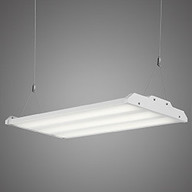
Linear high bays are long, rectangular fixtures that provide bright, even light across a wide area. These are particularly effective for warehouses with shelving and long aisles. The linear design allows for consistent light distribution, making it easier for workers to identify items on shelves and move around safely. Because of their shape, they can be easily installed in a continuous line, providing an uninterrupted flow of light along the length of the space.
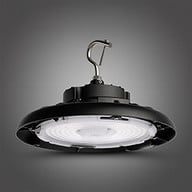
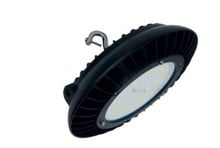
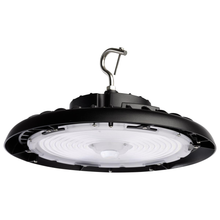
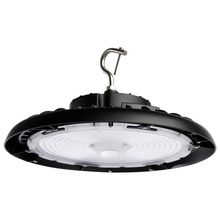
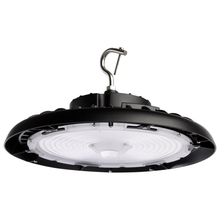
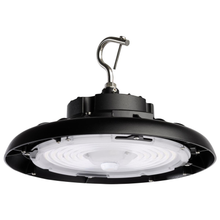
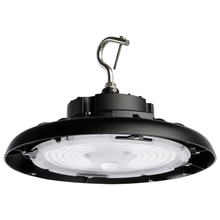
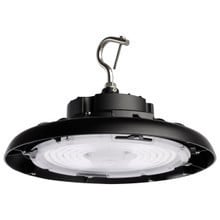
Round high bays, often referred to as UFOs due to their round, saucer-like shape, are versatile and can be used in a variety of settings. They’re particularly well-suited for spaces with higher ceilings, as they project a strong, focused light downward.
The design allows for heat to be more efficiently dissipated, contributing to a longer lifespan for the unit. Their compact and unobtrusive design makes them a go-to choice for areas where aesthetics are a consideration alongside functionality.
Adjustable lens high bays offer the flexibility to change the beam angle of the light, making them ideal for spaces that require targeted lighting. Whether you need focused light on a workstation or more diffused light to cover a broader area, these high bays give you the control to adjust as needed. This adaptability makes them particularly valuable in warehouses that have a mix of storage and workspaces.
Key Features to Look for in LED Warehouse High Bay Lighting
Choosing the right warehouse lighting is about more than just brightness and price. Here, we’ll examine the essential attributes that should inform your decision when picking the most efficient LED Warehouse High Bay light for your specific needs.
Luminous Efficacy
One of the first things to consider is the luminous efficacy of the lighting fixture, which is the light output per watt. This measures how efficiently a light source produces visible light, and it’s an excellent indicator of both performance and efficiency. A higher luminous efficacy means you’re getting more light while using less power, which will substantially lower your energy costs over time.
Color Temperature
The color temperature, measured in Kelvins (K), affects both the aesthetic and practical aspects of your warehouse lighting. Lower temperatures (around 2700K-3000K) produce warm, yellowish light, while higher temperatures (4000K-6000K) generate a cooler, bluish light. The latter is often preferred in warehouses because it tends to reduce eye strain and increase alertness among workers, contributing to both comfort and productivity.
Dimming and Controls
Having the ability to adjust brightness levels can be a significant asset in a warehouse setting. Dimming controls allow you to modify light output according to the specific tasks being performed, the time of day, or other requirements. Some advanced lighting systems can be integrated with smart control systems, allowing for remote adjustments and even automated settings based on sensors or time schedules.
Durability and Lifespan
Last but certainly not least, consider the durability of the light fixture, especially in a tough warehouse environment. Features like shatter-resistant lenses and a robust housing material can go a long way in extending the lifespan of your lighting fixtures. Furthermore, LEDs, in general, have a much longer lifespan compared to traditional lighting solutions, which means less frequent replacements and, consequently, lower maintenance costs.
Get Your Warehouse High Bay LEDs at Superior Lighting
Looking to make the switch to LED Warehouse High Bay Lighting? Superior Lighting is your trusted source for high-quality, energy-efficient lighting solutions designed to meet the unique needs of your warehouse or industrial facility.Contact our team today to find the right LED lighting solutions that will illuminate your warehouse while saving you money and energy in the long run.
Should I buy a linear high bay or a round UFO high bay? Which one is best?
Choosing between a Linear High Bay and a UFO High Bay can feel overwhelming when every building has different ceiling heights, layouts, and lighting needs. Both fixtures deliver strong, efficient illumination, but they perform differently depending on the environment. Understanding how each style distributes light ensures you choose the right one for long-term performance, safety, and visibility.
Linear high bays excel in spaces where aisles, shelves, or long work areas need clean, directional coverage. Their rectangular design spreads light evenly across narrow or wide rows, reducing dark spots and improving uniformity from end to end. They are a top choice for warehouses with racking, manufacturing lines, retail aisles, and gyms.
UFO high bays, by contrast, are compact, circular fixtures engineered for powerful downward illumination, ideal for large, open spaces with higher ceilings. Their round optical design delivers strong center-beam performance, and their lightweight construction makes installation simple. You will find them commonly used in open warehouses, workshops, and tall commercial spaces where wide, unobstructed lighting is needed.
If your space has structured aisles, choose Linear High Bays for the best uniformity. If your building is open and tall, UFO High Bays typically provide the strongest overall performance with fewer fixtures.
GUIDE 1: How to Choose the Right Linear High Bay — Lumens, Spacing & Layout Essentials
Selecting the right Linear High Bay involves more than wattage, it starts with understanding how much light your space actually needs and how the fixtures will be arranged. Lumens, spacing, mounting height, and footcandle requirements all play a key role in achieving an efficient and properly illuminated environment.
Different areas require different light levels. Storage aisles may need 20–30 footcandles, while manufacturing areas, gyms, and retail stores often require 40–70 footcandles for safety and productivity. Linear high bays are available in a wide lumen range (12,000 to 60,000 lumens), giving you the flexibility to match output to your application.
Spacing is just as important. A simple rule is the 1:1 spacing ratio, where fixture spacing matches the mounting height. For example, a 20-foot mounting height usually pairs well with around 20 feet of spacing. You’ll also want to choose the right length, 4-foot fixtures provide wider coverage, while 2-foot fixtures work well in tighter layouts or smaller rooms.
If flexibility matters, selectable wattage and color temperature versions allow you to fine-tune lighting levels now and adjust them in the future as your space evolves.
GUIDE 2: UFO High Bay vs. Linear High Bay — Which One Should You Choose?
Choosing between UFO high bay and linear high bay fixtures can make a big difference in how efficiently a space is illuminated. UFO high bays are round, compact fixtures that produce a powerful, focused beam, making them ideal for open warehouse floors, gyms, large workshops, distribution centers, and commercial facilities. Their circular design provides strong downward illumination and excellent heat dissipation, which contributes to long-term performance and high efficiency.
Linear high bays, on the other hand, are better suited for aisles, shelving, and long rows, because their rectangular shape distributes light more evenly from end to end. If your space has racking or requires light along narrow paths, linear may be the better option. But if you have wide, open floor space and high ceilings, UFO high bays often deliver better coverage with fewer fixtures. Understanding the layout and purpose of your space is the key to choosing the right style.
GUIDE 3: How to Choose the Right Output for UFO High Bay Lighting
Selecting the correct lumen rating for a UFO high bay is one of the most important steps in achieving proper lighting levels. Different ceiling heights and applications require different brightness levels. For ceilings between 15–20 feet, a 15,000-20,000 lumens is usually sufficient. For 20–30 foot ceilings, 20,000-30,000 lumens is more typical. When you get into 30–40 foot heights or very large industrial facilities, you may need more than 30,000 lumens to ensure your floor area receives adequate illumination.
Remember not to focus on wattage when estimating output. Two 150W fixtures from different brands may produce different lumen levels. Always compare lumens, beam angle, and mounting height together. Choosing the correct output ensures safety, visibility, and long-term efficiency.
GUIDE 4: How Color Temperature Impacts Productivity and Safety in High Bay Applications
Color temperature plays a larger role in workplace performance than most people realize. UFO high bay lights are commonly offered in 4000K (cool white) and 5000K (daylight). Coool white provides a balanced, clean light that works well in commercial environments where comfortable visibility is needed. Daylight 5000K is brighter and sharper, helping improve focus, alertness, reading accuracy, safety awareness, and overall productivity.
Many industrial and warehouse managers choose 5000K because it provides the highest visibility for machinery, inventory labels, and production tasks. Some high bay fixtures offer color-selectable options, allowing the user to choose between different color temperatures to match the environment. Selecting the right color temperature has a direct impact on worker comfort and workplace efficiency.
GUIDE 5: Wattage-Selectable High Bays — A Complete Buyer’s Guide
Wattage-selectable High Bay LED Fixtures have quickly become one of the most popular lighting technologies for warehouses, commercial buildings, and manufacturing facilities. Their ability to adjust brightness on-site makes them extremely flexible for evolving environments.
A wattage-selectable fixture includes multiple wattage and lumen output settings — for example, 100W/150W/200W in one unit. Adjusting the wattage changes the brightness, allowing installers or facility managers to optimize lighting without the need of dimmer.
This flexibility is valuable for several reasons. If a warehouse rearranges shelving or converts an area into a workshop, the lighting can be adjusted without purchasing new fixtures. Installers can also balance brightness during installation to achieve consistent light levels across the entire space. And because one fixture replaces multiple traditional SKUs, it reduces inventory complexity and future-proofing becomes simpler.
Use lower output for general storage, medium for busy work areas, and higher lumens for tall ceilings or detailed work such as assembly or inspection.
GUIDE 6: Why High Bay Retrofit Bulbs Are the Easiest Way to Upgrade Metal Halide & HID Lighting
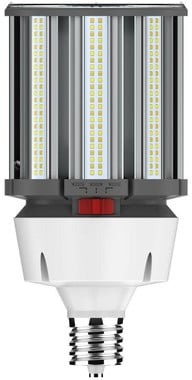
Upgrading traditional warehouse or industrial lighting used to mean replacing entire high bay fixtures, but LED highbay retrofit bulbs, often called LED corn bulbs, have changed everything. These bulbs allow you to convert old metal halide, high-pressure sodium, or mercury vapor fixtures into bright, energy-efficient LED systems without replacing the whole fixture. Simply remove or bypass the ballast, wiring line voltage directly to the socket, install the LED corn lamp, and the fixture runs like new.
Available in E26 and E39 base types, LED retrofit bulbs deliver significant energy savings, dramatically lower maintenance, and long lifespans that far outperform older technologies. They also offer instant-on performance, better visibility, and a wide variety of output options, from 100W HID all the way up to 1000W metal halide equivalents. For many commercial spaces, retrofit bulbs are the fastest, most cost-effective upgrade available.
GUIDE 7: Corn Lamp vs. Full Fixture Replacement — Which Upgrade Is Right for You?
When upgrading old HID lighting, customers must choose between corn lamp retrofits and LED highbay fixture replacements. Retrofit bulbs are faster, cheaper, and require little labor, perfect for situations where the existing fixtures are still in good condition. They allow you to modernize lighting quickly with minimal disruption.
Full fixture replacements, however, may be the better long-term solution when your current fixtures are damaged, outdated, or inefficiently designed. New LED high bay fixtures offer optimized optics, higher uniformity, and advanced controls such as motion sensors or dimming. Corn lamps are excellent for fast, economical upgrades, while full fixture replacements maximize lighting performance and customization. Evaluating the condition of your existing fixtures and deciding if a higher output is necessary makes choosing the right upgrade easy.